
Sale!

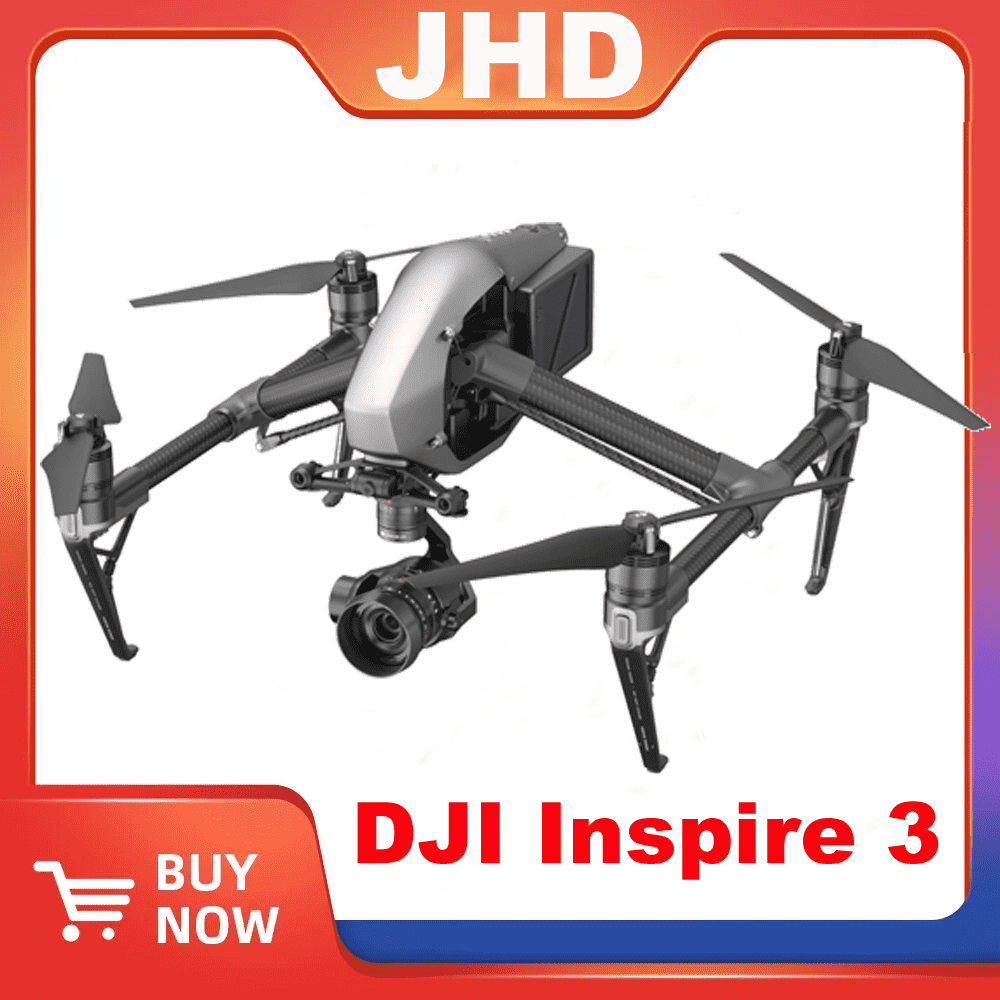
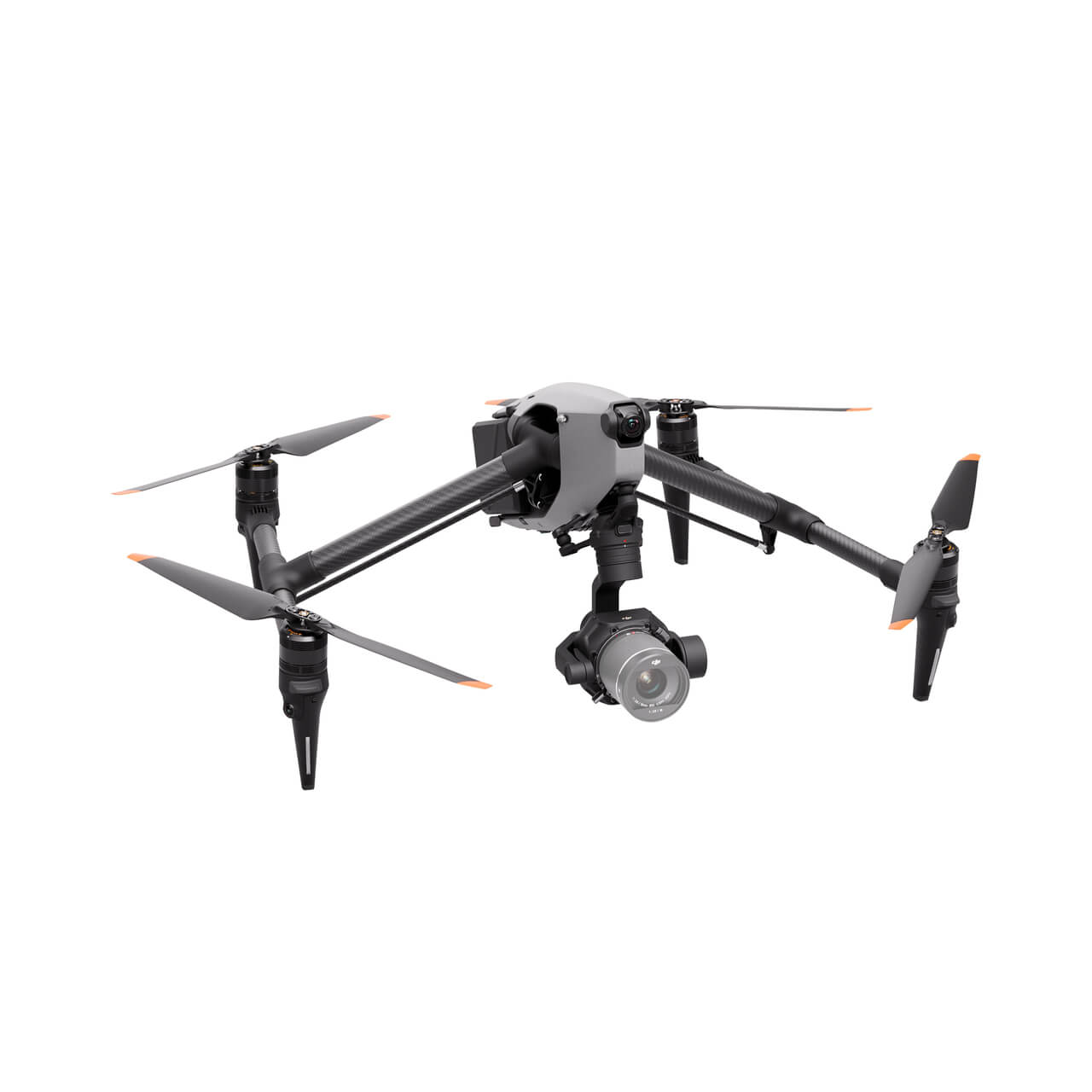
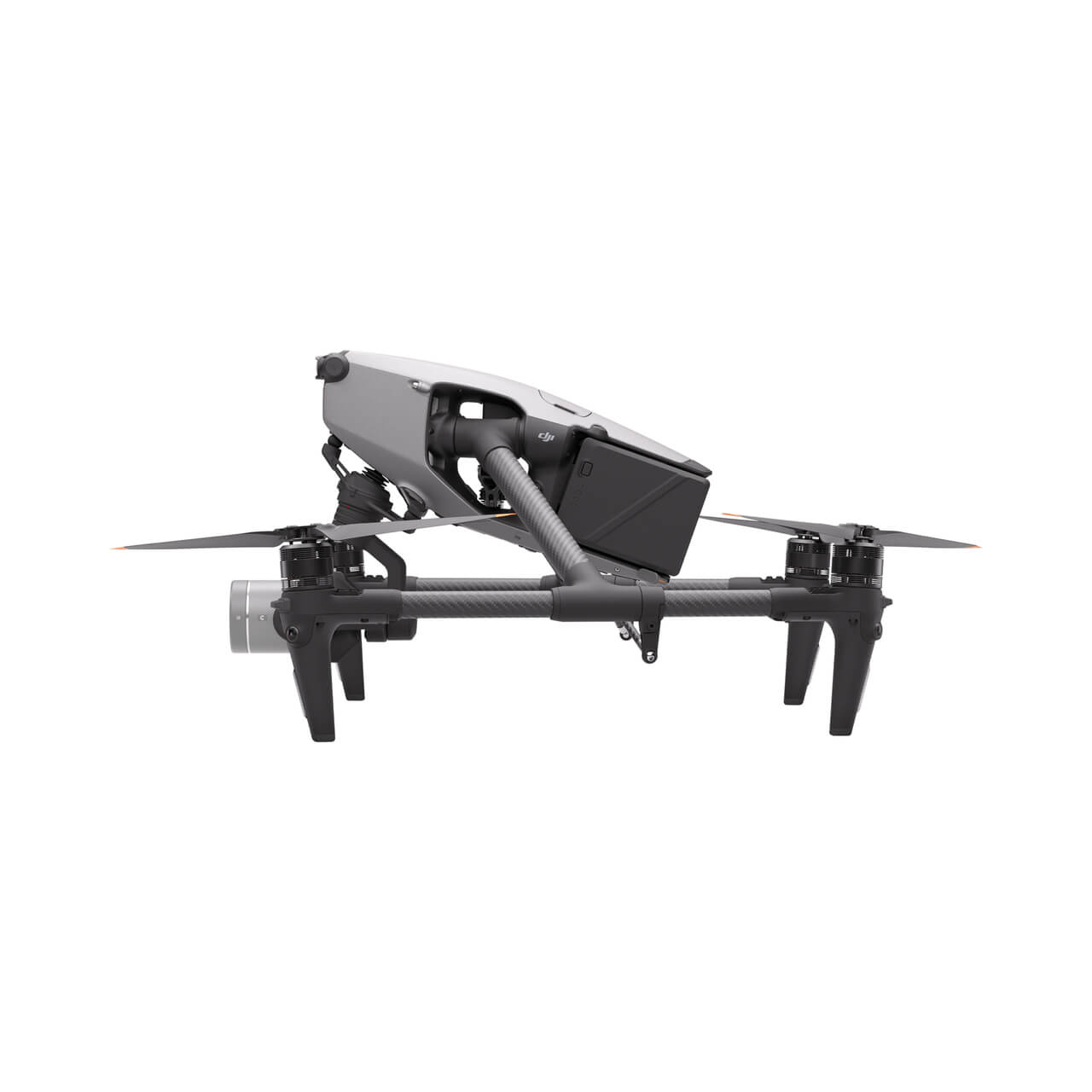
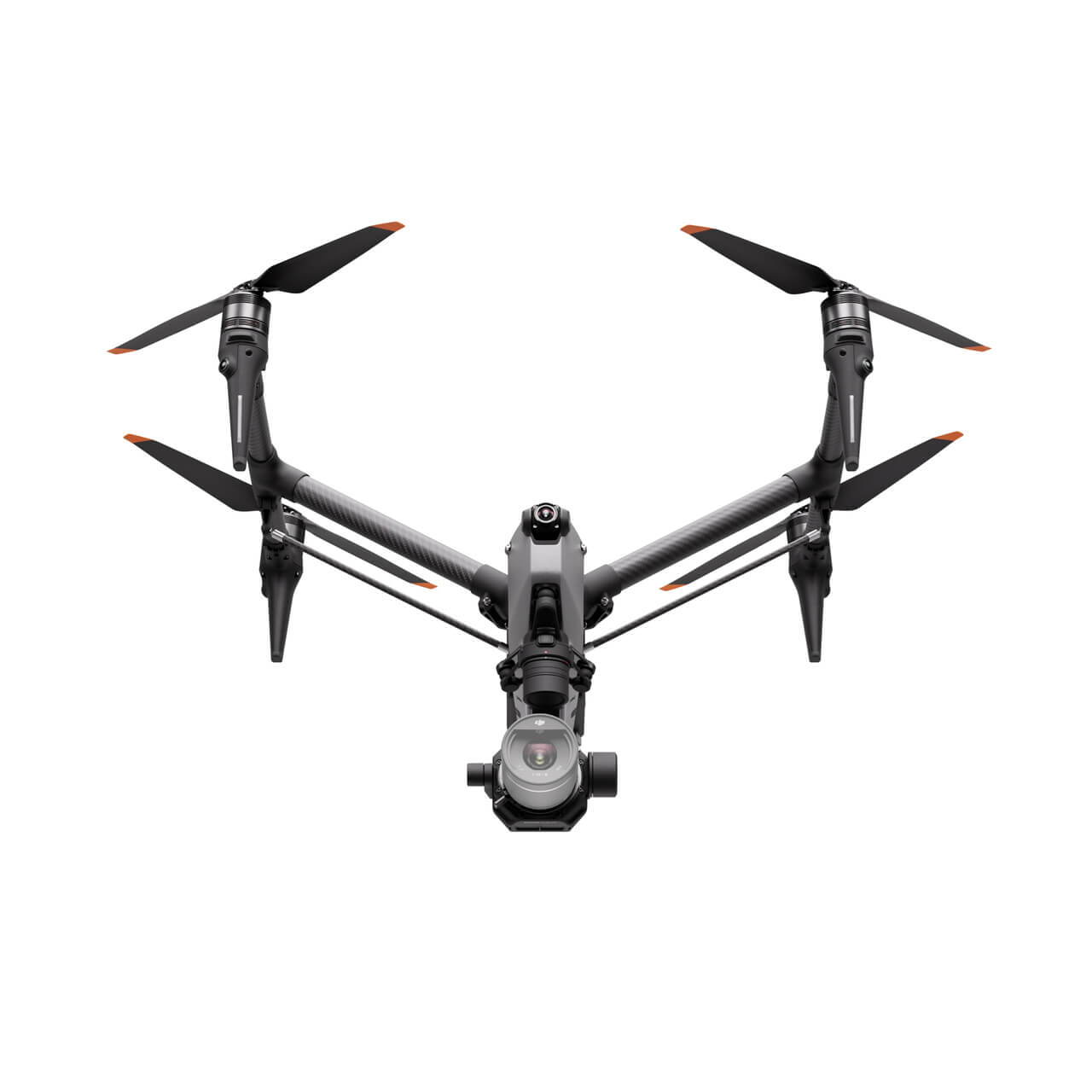
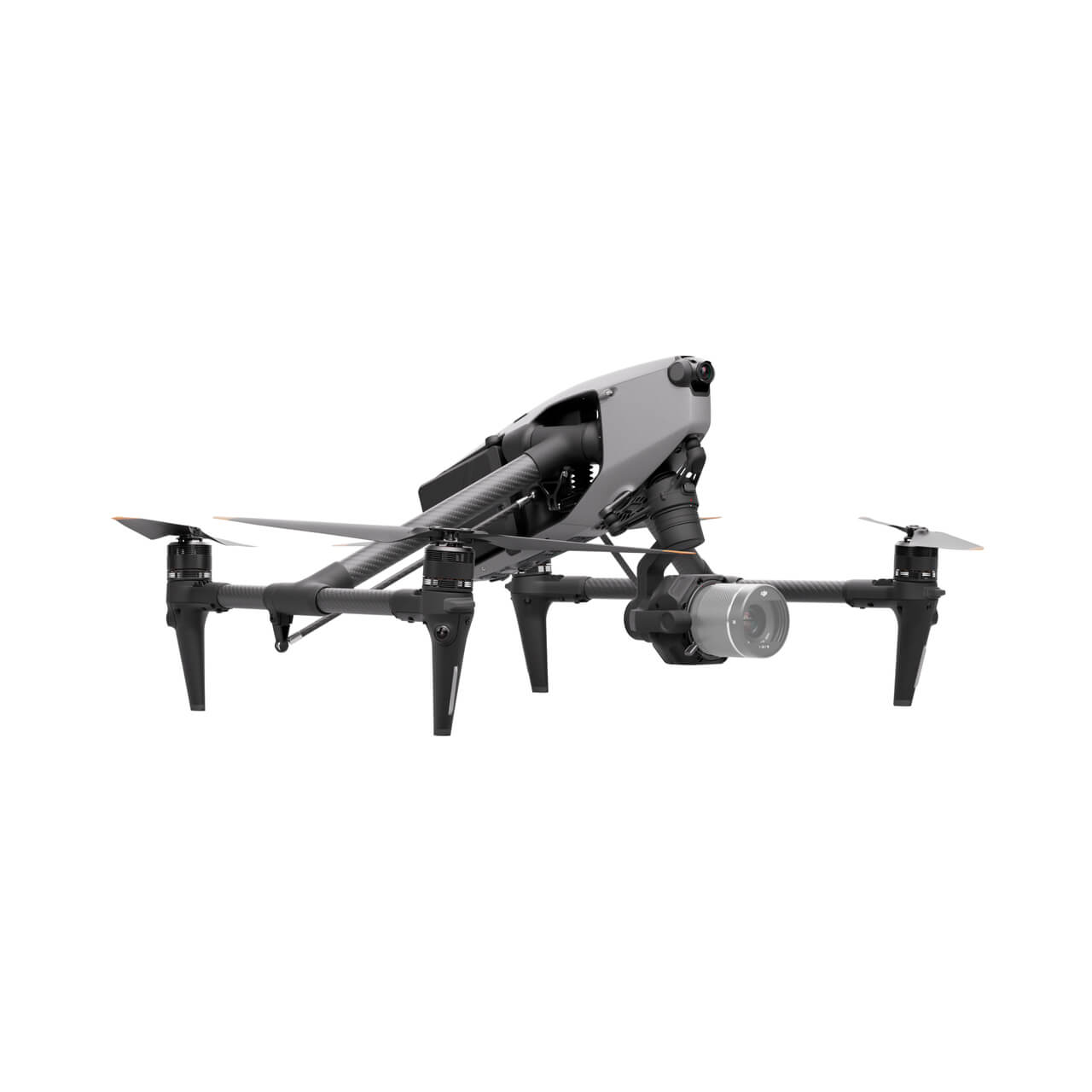
DJI Inspire 3 Drone

Original price was: $7,109.00.Current price is: $6,980.00.

DJI Inspire 3 Drone


Specs

Aircraft

  • Model

  • T740
  • Aircraft Weight

  • Approx. 3,995 g (includes gimbal camera, two batteries, lens, PROSSD, and propellers)
  • Max Takeoff Weight

  • Approx. 4,310 g
  • Hovering Accuracy Range

  • Vertical:
    ±0.1 m (with vision positioning)
    ±0.5 m (with GNSS positioning)
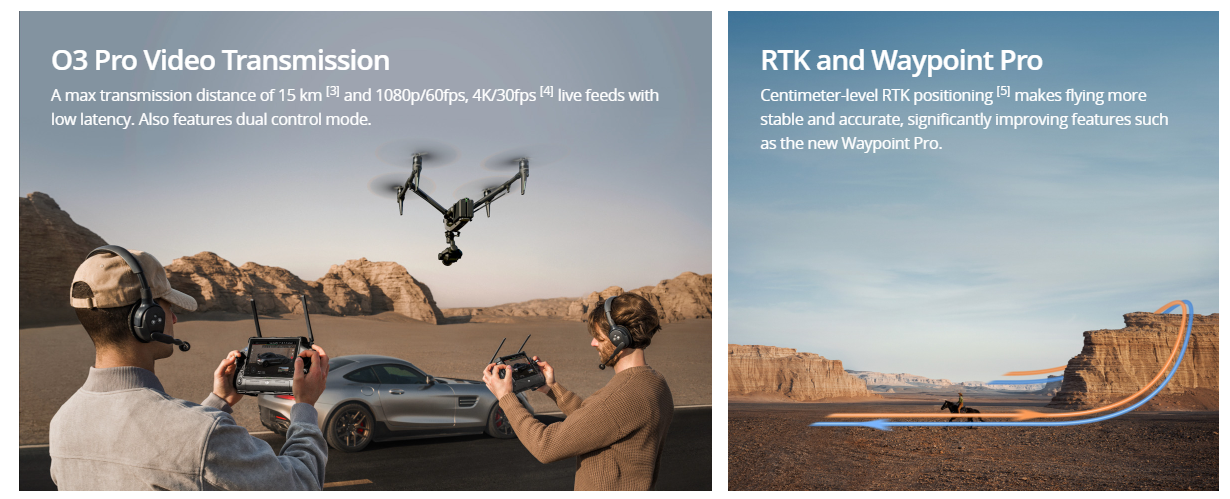
    ±0.1 m (with RTK positioning)

    Horizontal:
    ±0.3 m (with vision positioning)
    ±0.5 m (with GNSS positioning)
    ±0.1 m (with RTK positioning)

  • RTK Positioning Accuracy (RTK fix)

  • 1 cm + 1 PPM (horizontal)
    1.5 cm + 1 PPM (vertical)
  • Max Angular Velocity

  • Pitch: 200°/s
    Roll: 200°/s
    Yaw: 150°/s
  • Max Pitch Angle

  • N Mode: 35°
    S Mode: 40°
    A Mode: 35°
    T Mode: 20°
    Emergency Brake: 55°
  • Max Ascent Speed

  • 8 m/s
    Measured when flying in a windless environment at sea level, with gimbal camera and lens attached to the aircraft and without other accessories. This data is for reference only.
  • Max Descent Speed

  • Vertical: 8 m/s
    Tilt: 10 m/s
    Measured when flying in a windless environment at sea level, with gimbal camera and lens attached to the aircraft and without other accessories. This data is for reference only.
  • Max Horizontal Speed

  • 94 km/h
    Measured in a controlled wind tunnel environment under conditions equivalent to windless operation and sea-level altitude, with the aircraft (with gimbal camera and lens attached to the aircraft and without other accessories) ascending vertically to a height of 1.5 meters above the ground in Sport mode. Actual experience may vary depending on the environment, usage, and firmware version.
  • Max Service Ceiling Above Sea Level

  • Standard Propellers: 3800 m
    High-Altitude Propellers: 7000 m
    Measured in an environment with light wind with the gimbal camera and lens attached to the aircraft and without other accessories. This data is for reference only.
  • Max Wind Resistance

  • Takeoff/land: 12 m/s
    In-flight: 14 m/s
    Measured when flying at sea level, with gimbal camera and lens attached to the aircraft and without other accessories. This data is for reference only.
  • Max Hovering Time

  • Approx. 25 minutes
    Measured when hovering in a windless environment at sea level with gimbal camera and lens attached to the aircraft and without other accessories, with landing gear raised, and recording 4K/24fps H.264 (S35) video until the battery reached 0%. This data is for reference only. Please refer to the actual values in the app.
  • Max Flight Time

  • Approx. 28 minutes (landing gears lowered)
    Approx. 26 minutes (landing gears raised)
    Measured in a controlled wind tunnel environment under conditions equivalent to windless operation and sea-level altitude, with the aircraft (with gimbal camera and lens attached to the aircraft and without other accessories) flying forward at a constant speed of 36 kph, Obstacle Avoidance Action set to Brake, and the camera set to record 4K/24fps H.264 (S35) video, until a forced landing due to battery depletion. Actual experience may vary depending on the environment, usage, and firmware version.
  • Motor Model

  • DJI 3511s
  • Global Navigation Satellite System

  • GPS + Galileo + BeiDou
  • Propeller Model

  • Standard Propellers: DJI 1671
    High-Altitude Propellers: DJI 1676
  • Operating Temperature

  • -20° to 40° C (-4° to 104° F)
  • Diagonal Distance

  • Landing Gear Raised: 695 mm
    Landing Gear Lowered: 685 mm
  • Travel Mode Dimensions

  • Height: 176 mm
    Width: 709.8 mm
    Length: 500.5 mm
  • Class

  • C3 (EU)

Gimbal Camera

  • Sensor

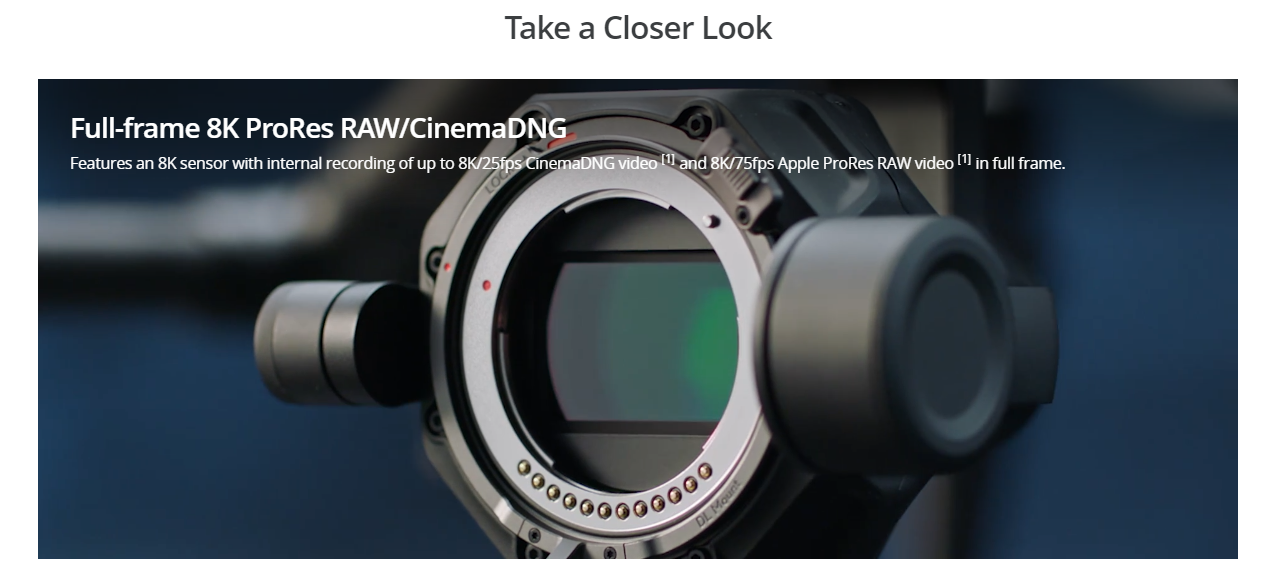
  • 35mm full-frame CMOS
  • Max Resolution

  • Photo: 8192×5456
    Video: 8192×4320
  • Supported Lenses

  • DL 18 mm F2.8 ASPH Lens
    DL 24 mm F2.8 LS ASPH Lens
    DL 35 mm F2.8 LS ASPH Lens
    DL 50 mm F2.8 LS ASPH Lens
    DL 75 mm F1.8 Lens
  • Photo Format

  • JPG, DNG
  • Video Format

  • MOV, CinemaDNG
  • Operation Mode

  • Capture, Record, Playback
  • Exposure Mode

  • P, A, S, M
  • Shutter Type

  • Electronic shutter
  • Shutter Speed

  • 8-1/8000 s
  • White Balance

  • AWB
    MWB (2000K-10000K)
  • ISO Range

  • Photo
    ISO: 100-25600

    Video
    EI: 200-6400

  • Anti-flicker

  • Capture Mode: Auto, 50 Hz, 60 Hz, OFF
  • Angular Vibration Range

  • Hovering: ±0.002°
    Flying: ±0.004°
  • Installation Method

  • Quick release
  • Mechanical Range

  • Tilt:
    -128° to +110° (landing gear lowered)
    -148° to +90° (landing gear raised)
    Roll: -90° to +230°
    Pan: ±330°
  • Controllable Range

  • Tilt (landing gear lowered):
    Before gimbal tilt limit extension: -90° to +30°
    After gimbal tilt limit extension: -115° to +100°
    Tilt (landing gear raised):
    Before gimbal tilt limit extension: -90° to +30°
    After gimbal tilt limit extension: -140° to +75°
    Roll: ±20°
    Pan: ±300°
  • Max Control Speed

  • With DJI RC Plus:
    Tilt: 120°/s
    Roll: 180°/s
    Pan: 270°/s

    With DJI Master Wheels:
    Tilt: 432°/s
    Roll: 432°/s
    Pan: 432°/s

  • Weight

  • Approx. 516 g (without lens)

Video Transmission

  • Video Transmission System

  • O3 Pro
  • Live View Quality

  • FPV Camera: Up to 1080p/60fps
    Gimbal Camera: Up to 1080p/60fps, 4K/30fps
  • Max Live Video Bitrate

  • 50 Mbps
  • Max Transmission Distance

  • Single Control Mode:
    FPV Camera: approx. 15 km (FCC), 8 km (CE/SRRC/MIC)
    Gimbal Camera (1080p/60fps live feeds): approx. 13 km (FCC), 7 km (CE/SRRC/MIC)
    Gimbal Camera (4K/30fps live feeds): approx. 5 km (FCC), 3 km (CE/SRRC/MIC)

    Dual-Control Mode:
    FPV Camera: approx. 12 km (FCC), 6.4 km (CE/SRRC/MIC)
    Gimbal Camera (1080p/60fps live feeds): approx. 11.2 km (FCC), 5.6 km (CE/SRRC/MIC)
    Gimbal Camera (4K/30fps live feeds): approx. 4 km (FCC), 2.4 km (CE/SRRC/MIC)
    Measured in an unobstructed outdoor environment free of interference, with gimbal camera and lens attached to the aircraft and without other accessories. The above data shows the farthest communication range for one-way, non-return flights under each standard. During your flight, please pay attention to reminders in the app.
  • Lowest Latency

  • FPV Camera: 90 ms
    Gimbal Camera: 90 ms
    The lowest latency of the gimbal camera was measured when recording 4K/60fps ProRes RAW video. The lowest latency of the FPV camera was measured with strong video transmission signals.
  • Operating Frequency

  • 2.4000-2.4835 GHz
    5.150-5.250 GHz (CE: 5.170-5.250 GHz)
    5.725-5.850 GHz
    In some countries and regions, the 5.1 and 5.8GHz frequencies are prohibited, or the 5.1GHz frequency is only allowed for indoor use. Please refer to local laws and regulations.
  • Transmitter Power (EIRP)

  • 2.4 GHz: <33 dBm (FCC), <20 dBm (CE/SRRC/MIC)
    5.1 GHz: <23 dBm (CE)
    5.8 GHz: <33 dBm (FCC), <30 dBm (SRRC), <14 dBm (CE)

Battery

  • Model

  • TB51 Intelligent Battery
  • Capacity

  • 4280 mAh
  • Nominal Voltage

  • 23.1 V
  • Type

  • Li-ion
  • Chemical System

  • LiCoO2
  • Energy

  • 98.8 Wh
  • Weight

  • Approx. 470 g
  • Operating Temperature

  • -20° to 40° C (-4° to 104° F)
  • Charging Temperature

  • -20° to 40° C (-4° to 104° F)
    If the temperature of the battery is lower than 10° C (50° F), the battery will trigger an auto-heating function. Charging in a low-temperature environment below 0° C (32° F) may shorten battery life.
  • Max Charging Power

  • 205.5 W
  • Charge via Aircraft

  • Not supported

Battery Charging Hub

  • Input

  • 100-240 V AC, max 8 A
  • Output

  • 26.4 V, 7.8 A
  • Total Rated Output

  • 476 W, including 65W PD fast charging of USB-C port
  • Charging Time

  • Fast Mode: Approx. 35 minutes to 90%
    Standard Mode: Approx. 55 minutes to 100%
    Silent Mode: Approx. 80 minutes to 100%
    Tested at a room temperature of 25° C (77° F) and in a well-ventilated environment. In Fast mode, each battery pair is charged to 90% in sequence, and then eight batteries are charged together to 100%.
  • Charging Temperature

  • -20° to 40° C (-4° to 104° F)
  • Weight

  • Approx. 1,680 g

Memory Card

  • Memory Card Type

  • DJI PROSSD 1TB

Sensing

  • Forward

  • Measurement Range: 1.5-48 m
    Effective Sensing Speed: ≤15 m/s
    FOV:
    Horizontal 90°, Vertical 103° (landing gear raised)
    Horizontal 72°, Vertical 103° (landing gear lowered)
  • Backward

  • Measurement Range: 1.5-48 m
    Effective Sensing Speed: ≤15 m/s
    FOV: Horizontal 90°, Vertical 103°
  • Lateral

  • Measurement Range: 1.5-42 m
    Effective Sensing Speed: ≤15 m/s
    FOV: Horizontal 90°, Vertical 85°
  • Upward

  • Measurement Range: 0.2-13 m
    Effective Sensing Speed: ≤6 m/s
    FOV: Front and Back 100°, Left and Right 90°
  • Downward

  • Measurement Range: 0.3-18 m
    Effective Sensing Speed: ≤6 m/s
    FOV: Front and Back 130°, Left and Right 160°
  • Operating Environment

  • Forward, Backward, Left, Right, and Upward: surfaces with discernible patterns and adequate lighting (lux >15)
    Downward: surfaces with discernible patterns and diffuse reflectivity >20% (e.g., walls, trees, people); adequate lighting (lux >15)
    Obstacle sensing is disabled while the landing gear is in the process of being raised or lowered.
  • ToF Infrared Sensor Measurement Range

  • 0-10 m

Remote Controller

  • Model

  • RM700B
  • Operating Time

  • Built-in Batteries: approx. 3.3 hours
    Built-in Batteries Plus External Battery: approx. 6 hours
  • Operating Frequency

  • 2.4000-2.4835 GHz
    5.725 GHz-5.850 GHz
    In some countries and regions, 5.1GHz and 5.8GHz frequencies are prohibited, or the 5.1GHz frequency is only allowed for indoor use. Please refer to local laws and regulations.
  • Video Output Port

  • HDMI
  • Power Supply

  • Built-in batteries or external battery
  • Coordinated Operation

  • Supports dual controls and coordination between multiple operators
  • Power Consumption

  • 12.5 W
  • Operating Temperature

  • -20° to 50 °C (-4° to 122° F)
  • Storage Temperature

  • -30° to 45° C (-22° to 113° F) (within one month)
    -30° to 35° C (-22° to 95° F) (one to three months)
    -30° to 30° C (-22° to 86° F) (three months to one year)
  • Battery

  • Built-in Battery: 3250mAh-7.2V (a set)
    External Battery: WB37 Intelligent Battery
  • Wi-Fi Protocol

  • Wi-Fi 6
  • Wi-Fi Operating Frequency

  • 2.4000-2.4835 GHz
    5.150-5.250 GHz
    5.725-5.850 GHz
  • Wi-Fi Transmitter Power (EIRP)

  • 2.4 GHz: <26 dBm (FCC), <20 dBm (CE/SRRC/MIC)
    5.1 GHz: <26 dBm (FCC), <23 dBm (CE/SRRC/MIC)
    5.8 GHz: <26 dBm (FCC/SRRC), <14 dBm (CE)
  • Bluetooth Protocol

  • Bluetooth 5.1
  • Bluetooth Operating Frequency

  • 2.4000-2.4835 GHz
  • Bluetooth Transmitter Power (EIRP)

  • < 10 dBm

App

  • App

  • DJI Pilot 2

FPV Camera

  • FOV

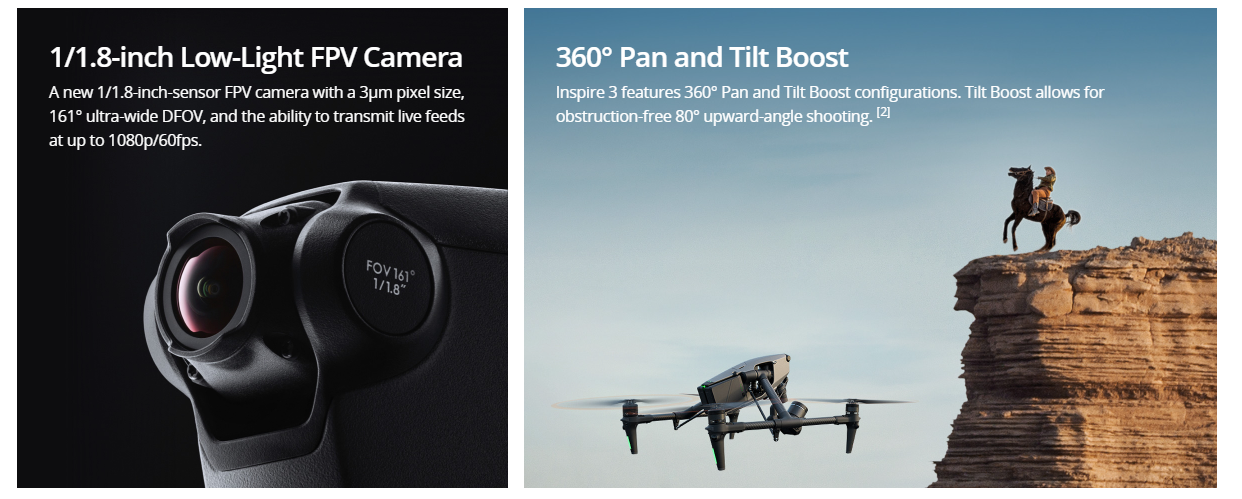
  • 161°
  • Resolution

  • 1920×1080@60fps

Footnotes

  • The terms HDMI, HDMI High-Definition Multimedia Interface, HDMI Trade dress and the HDMI Logos are trademarks or registered trademarks of HDMI Licensing Administrator, Inc.

Others

  • Guaranteed software updates until

  • 2026/12/31


Compatibility

Can I use DJI Inspire 3 with the X9 gimbal camera, TB50 battery, and storage card of DJI Ronin 4D interchangeably?
The gimbal camera and TB50 battery are not interchangeable. The storage card is interchangeable.

To improve DJI Inspire 3’s battery life, flight experience, and performance and stability at all attitudes and speeds, Inspire 3’s X9-8K Air gimbal camera has been optimized specially for aerial photography. Compared with the X9-6K and X9-8K gimbal cameras of Ronin 4D, the X9-8K Air’s weight is reduced by approximately 50% with a centralized center of gravity, ensuring an improved flight time and flight experience. Additionally, the gimbal axis arms and lens locking design adopt optimized vibration-proof designs for aerial photography so that the aircraft can stay stable even during dramatic or high-speed flight maneuvers.

The new TB51 battery features higher energy density with reduced weight, and size, which is beneficial for the total flight time and wind resistance when flying forward, and is more advantageous than TB50 in terms of discharge voltage and reliability.

The DJI PROSSD 1TB of DJI Ronin 4D is interchangeable with Inspire 3.

Both the X9-6K and X9-8K gimbal cameras of DJI Ronin 4D weigh approximately 1.04 kg, while the X9-8K Air of DJI Inspire 3 weighs approximately 516 g, for a weight reduction of approximately 50%.

Are the gimbal camera, remote controller, storage card, and battery of DJI Inspire 3 interchangeable with those of DJI Inspire 2?
No.

All modules of DJI Inspire 3 have been redesigned to deliver fully upgraded performance in terms of flight, imaging, video transmission, storage, and battery life.

Gimbal Camera: DJI Inspire 3 comes with the X9-8K Air gimbal camera with a newly designed gimbal camera quick-release port that meets the data transmission requirements of 8K CinemaDNG videos, and further ensures stable gimbal connection during flight.

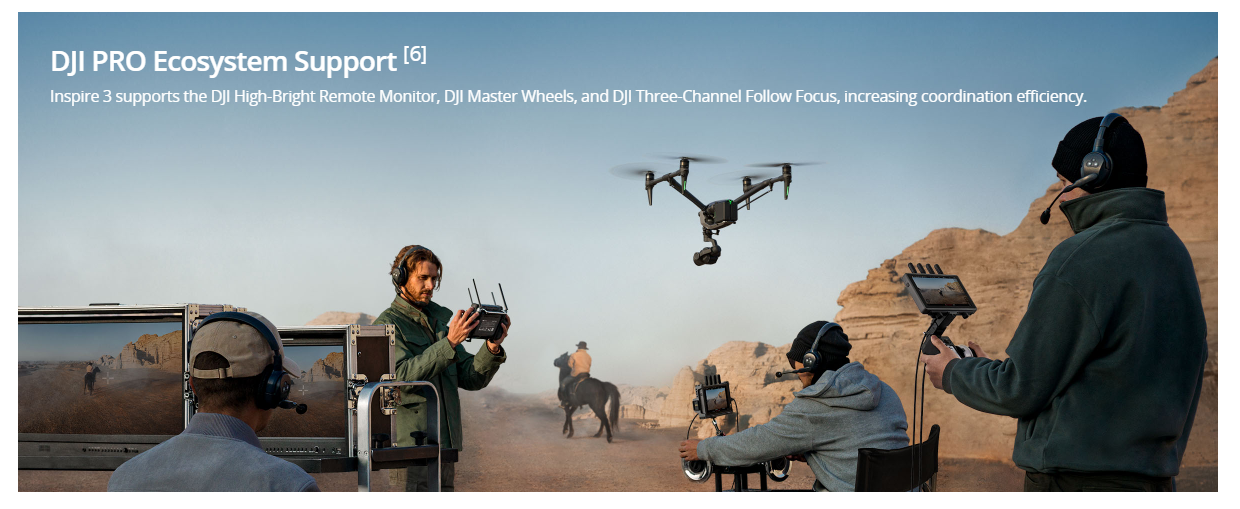
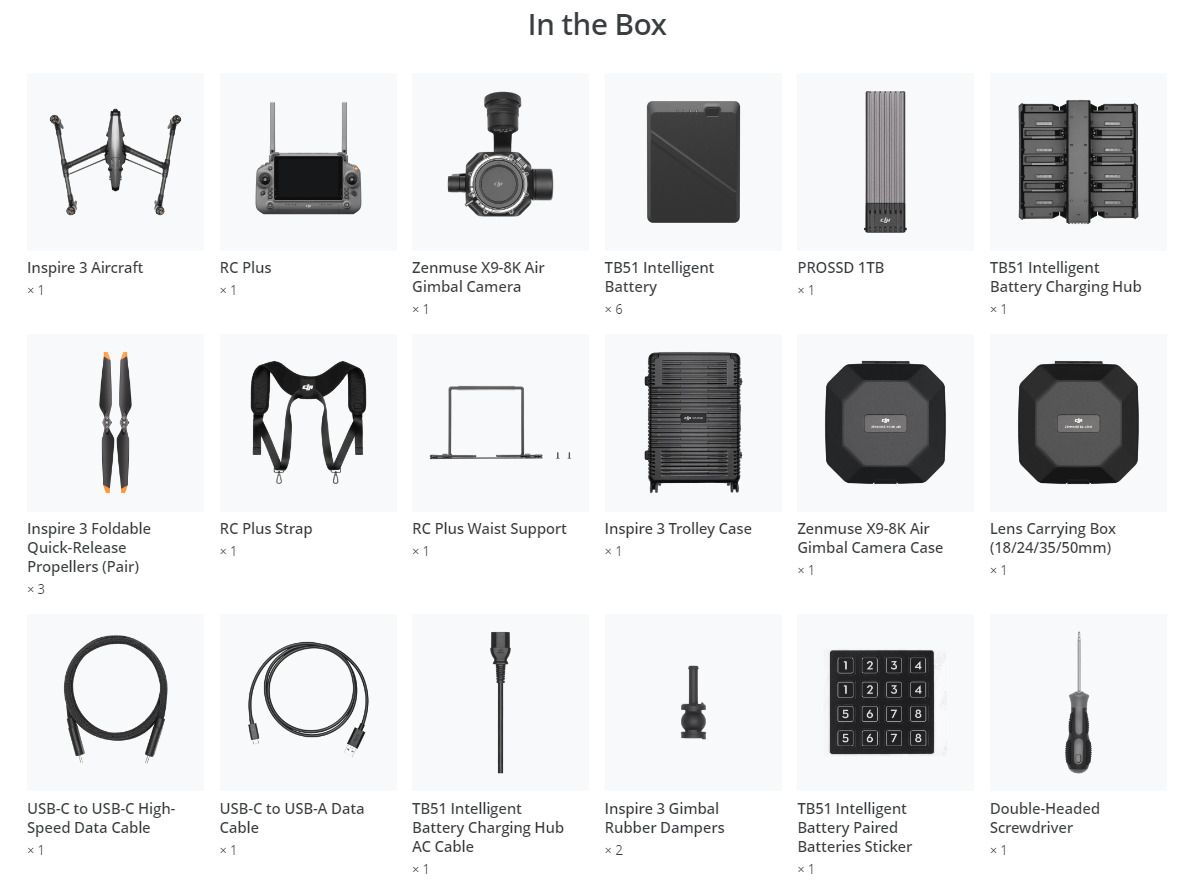
Remote Controller: DJI Inspire 3 comes with the professional-level DJI RC Plus and professional accessories such as a strap and waist support. The DJI RC Plus supports O3 Pro, a cinema-grade video transmission system that has taken a generational leap in transmission distance, latency, and overall stability. The 7-inch high-bright screen delivers up to 1,200-nits of brightness to provide an extraordinary outdoor monitoring experience. It also features several buttons and dials on the front, back, and top, which enable fast and intuitive operation. Button functions can also be customized. The built-in battery of RC Plus provides an operating time of approximately 3.3 hours, and extends to 6 hours with an external WB37 battery. It also supports battery hot-swapping to improve creative efficiency. On top of the classic flight control interface, the new DJI Pilot 2 app for Inspire adds a cinema-grade monitoring interface, which allows simple and convenient checking of information like camera exposure, video specifications, focal length, and gimbal angle, easily meeting the monitoring requirements of gimbal operators and DPs.

Storage: The included DJI PROSSD 1TB supports a max read speed of 900MBps for recording high-frame-rate videos of 8K CinemaDNG, and the footage can be read on a computer directly through the provided USB-C to USB-C cable without the need for a card reader, convenient for DITs.

Battery: DJI Inspire 3 is equipped with six TB51 intelligent batteries and an all-new battery charging hub. TB51 batteries utilize the latest battery chemistry technology for optimized reliability and performance, and are smaller, lighter, more streamlined, and higher voltage compared to TB50. They provide a 28-minute max flight time and support hot swapping. The all-new foldable battery charging hub can accommodate eight batteries. In Fast mode, it can charge two batteries to 90% in just 35 minutes and eight batteries to 100% in only 160 minutes. The included 65W USB-C port can also be used to charge an RC Plus.

Measured using the included USB-C to USB-C data cable with an Apple MacBook Pro 2021 (Apple M1 Max chip). Measured when flying forward at a constant speed of 36 kph with the landing gear down in a windless environment at sea level, with gimbal camera and lens attached to the aircraft and without other accessories, and recording 4K/24fps H.264 (S35) video until the battery reached 0%. This data is for reference only. Please refer to the actual values in the app. Tested when charging two batteries to 90% and to 100% with the battery charging hub at a room temperature of 25° C (77° F) in a well-ventilated environment. This data is for reference only.

Aircraft

Compared to DJI Inspire 2, what major upgrades does Inspire 3 have?
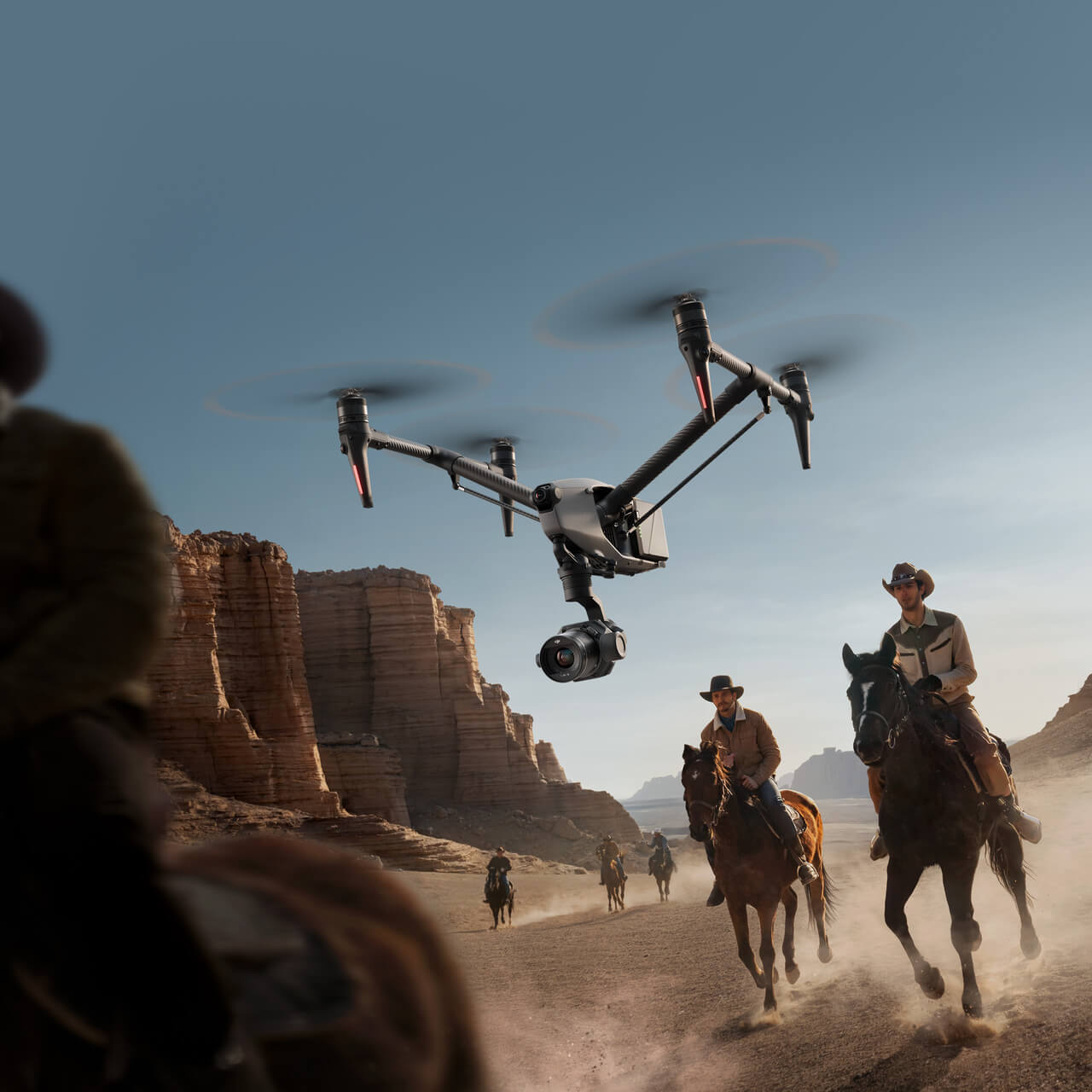
DJI Inspire 3 features a sleek and integrated design, a high-mobility flight system, a full-frame 8K imaging system, O3 Pro video transmission and control system, and efficient full-scenario operation. Compared with DJI Inspire 2, the image quality and operation efficiency of Inspire 3 is significantly improved. This delivers greater creative freedom and an enhanced aerial cinematography experience.
What is DJI Inspire 3’s max horizontal speed?
94 kph

Measured when flying in a windless environment with gimbal camera and lens attached to the aircraft and without other accessories. Data is for reference only.

What is DJI Inspire 3’s max takeoff weight?
Approx. 4310 g
What is DJI Inspire 3’s max wind resistance?
12 m/s during takeoff/landing, and 14 m/s during flight.

Measured when flying in a windless environment at sea level, with gimbal camera and lens attached to the aircraft and without other accessories. Data is for reference only.

What DJI Inspire 3’s max flight time?
Inspire 3’s max hovering time is approx. 25 minutes, and the max forward flying time is approx. 28 minutes.

The max hovering time was measured when hovering in a windless environment at sea level with gimbal camera and lens attached to the aircraft and without other accessories, with landing gear raised, and recording 4K/24fps H.264 (S35) video until the battery reached 0%. The forward flying time was measured when flying forward at a constant speed of 36 kph in a windless environment at sea level, with gimbal camera and lens attached to the aircraft and without other accessories, with landing gear lowered and recording 4K/24fps H.264 (S35) video until the battery reached 0%. This data is for reference only. Please refer to the actual values in the app.

Does Inspire 3 have an obstacle sensing system?
Yes. Inspire 3 is equipped with an omnidirectional visual sensing system to detect obstacles in all directions, providing comprehensive protection for flying.

Obstacle sensing is disabled while the landing gear is in the process of being raised or lowered. When the landing gear is down, there are obstacle-avoidance blind spots at the front-left and front-right areas of the aircraft of approximately 20°.
How do I achieve the largest tilt and pan angles with the DJI Inspire 3 gimbal camera?
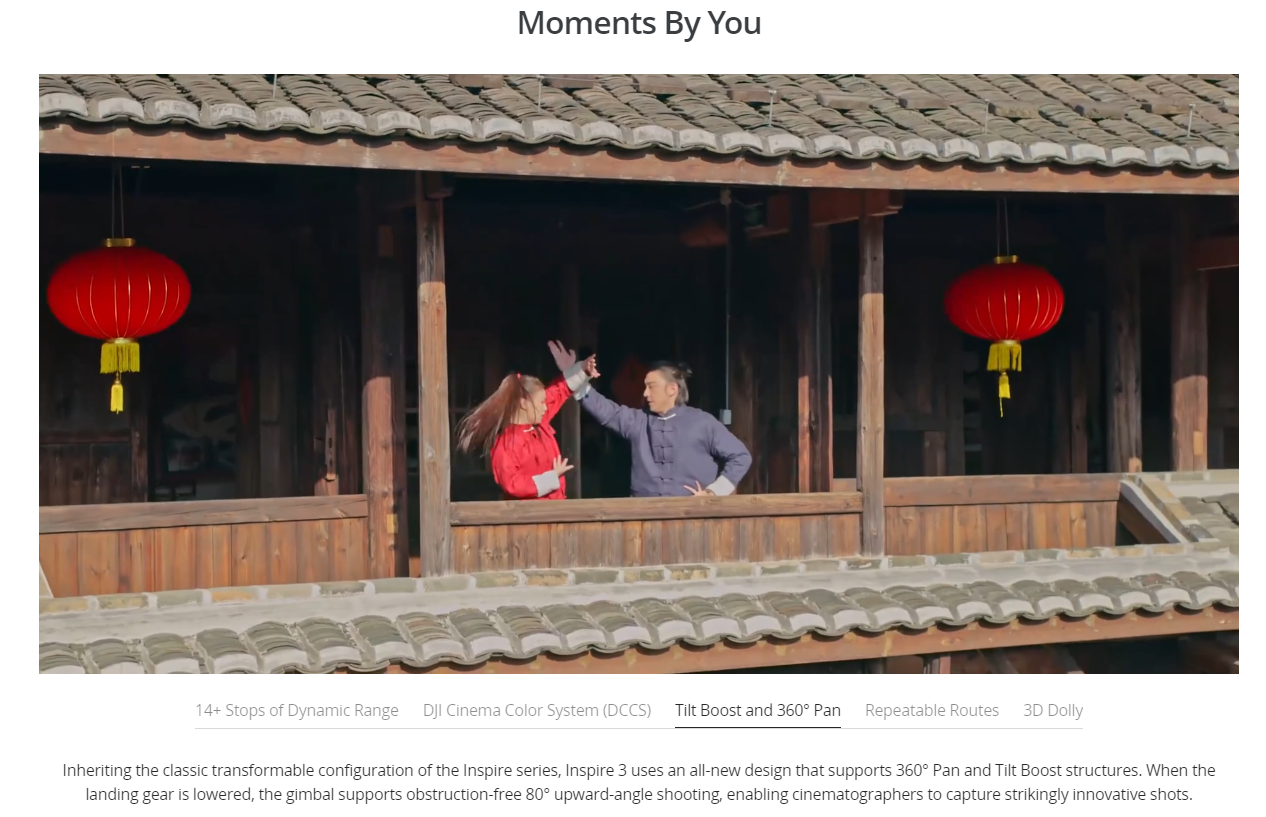
When the landing gear of DJI Inspire 3 is raised, it supports 360° pan shooting obstruction-free. When the landing gear is lowered and the gimbal camera faces forward, it can achieve 80° tilt shooting obstruction-free.
What are the dimensions of DJI Inspire 3?
When the landing gear is raised, the diagonal distance is approx. 695 mm;
When the landing gear is lowered, the diagonal distance is approx. 685 mm;
Travel Mode Dimensions 500.5×709.8×176 mm (length×width×height).
Can I control the tilt axis of the FPV camera?
Yes. When the remote controller is using the default settings, turn the wheel on the upper left to control the tilt axis.

Reviews

There are no reviews yet.

Be the first to review “DJI Inspire 3 Drone”

Your email address will not be published. Required fields are marked *

Shopping Cart
Scroll to Top